
Think about a smart security camera that detects movement. Instead of sending every second of video to a remote server, it can analyse footage locally and send only relevant alerts. That is a simple example of edge computing.
What Is Edge Computing and How Does It Work?
Edge computing brings computing power and data processing closer to the devices and locations generating information. These locations are commonly called the network edge.
Traditional cloud-based systems often send information from connected devices to centralised data centres for processing. Edge computing changes this approach by allowing some processing to happen on the device itself, a nearby gateway, or a local edge server.
For example, consider a manufacturing facility with hundreds of machines. Each machine generates information about temperature, pressure, vibration, and performance. A nearby edge server can analyse this information, identify unusual behaviour, and alert operators without waiting for every data point to travel to a distant cloud server.
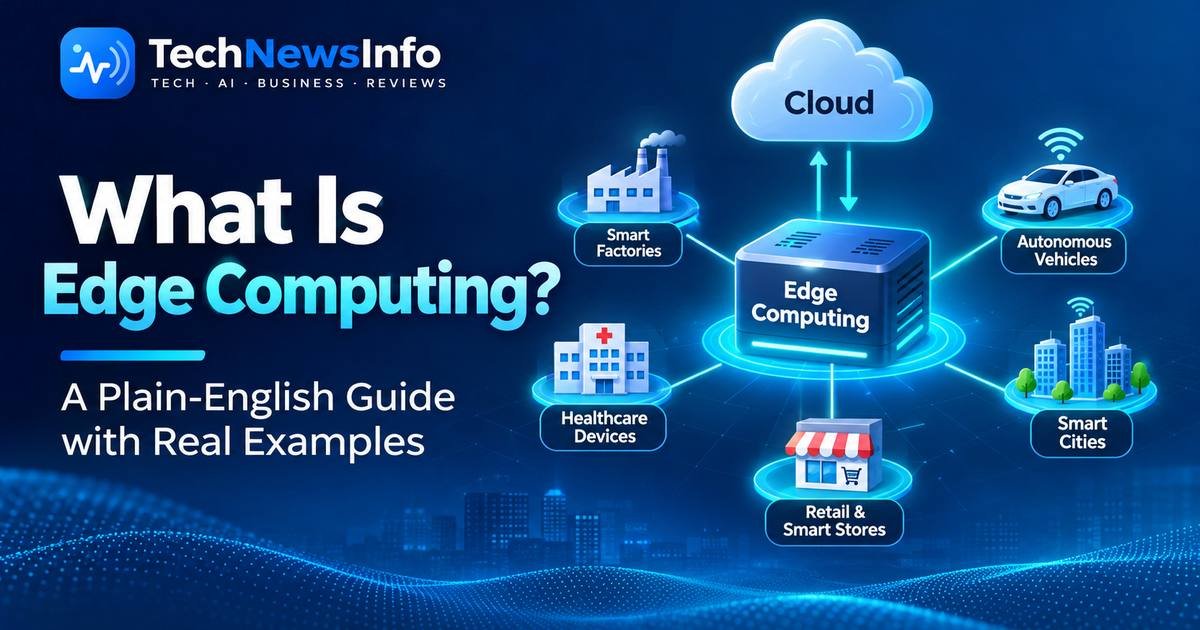
An edge computing environment generally includes three important components:
- Edge devices: Sensors, cameras, industrial machines, smartphones, and IoT devices that generate or collect information.
- Edge gateways and servers: Local computing systems that process, filter, analyse, and temporarily store data.
- Cloud infrastructure: Centralised computing resources used for long-term storage, advanced analytics, application management, and larger workloads.
These components work together. Edge infrastructure handles tasks that need quick local responses, while cloud infrastructure supports broader computing and data management requirements.
How Does Edge Computing Work? (Step-by-Step)
Edge computing typically follows a simple process. The exact architecture depends on the application, devices, and business requirements.
- Data generation: Sensors, cameras, machines, or connected devices collect information from their surroundings.
- Data transmission: The information is sent to a nearby edge gateway, device, or server.
- Local processing: The edge system filters, analyses, or processes the information locally.
- Immediate action: The system can trigger an alert, adjust equipment, or perform another predefined action when necessary.
- Cloud synchronisation: Relevant information, summaries, or processed results are transferred to cloud infrastructure for storage and further analysis when required.
For example, a factory temperature sensor can send readings to a local controller. If the temperature exceeds a configured limit, the system can trigger an alert or initiate a safety response. Historical readings can also be transferred to the cloud for reporting and trend analysis.
What Are Some Real-World Edge Computing Examples?
Edge computing is useful in environments where connected devices generate large amounts of information or where applications need to respond quickly.
1. Smart Factories and Industrial Automation
Manufacturing facilities use connected sensors, industrial controllers, and machines to monitor production processes.
Edge computing allows factories to analyse machine performance, identify unusual vibration patterns, monitor equipment temperatures, and support predictive maintenance. Local processing can help operators identify potential equipment problems before they interrupt production.
For instance, an industrial machine can send sensor readings to an edge server. If the system detects an abnormal operating pattern, it can notify the maintenance team immediately.
2. Autonomous Vehicles
Autonomous and advanced driver-assistance systems process information from cameras, radar, lidar, and other vehicle sensors.
Time-sensitive driving decisions require processing close to the vehicle. Sending every sensor reading to a distant cloud server and waiting for a response would introduce unnecessary communication delays.
Onboard computing systems therefore analyse surrounding conditions and support immediate driving-related decisions. Cloud systems can still support map updates, fleet management, and other non-immediate workloads.
3. Healthcare and Medical Devices
Connected medical devices and patient-monitoring systems can generate continuous streams of information, including heart rate, oxygen levels, and other measurements.
Edge computing can support local processing of this information, helping monitoring systems identify readings that require attention without depending entirely on a remote cloud connection.
For example, a connected monitoring device may analyse readings locally and generate an alert when a configured threshold is crossed. Healthcare organisations must still implement appropriate privacy, security, clinical validation, and regulatory safeguards.
4. Smart Cities and Traffic Management
Smart city infrastructure uses traffic cameras, road sensors, connected signals, and environmental monitoring devices.
Edge computing can process information close to intersections and public infrastructure. Traffic management systems may use local analysis to identify congestion, detect incidents, and adjust signal timing according to configured rules.
This can help reduce the need to transmit every video frame or sensor reading to a central data centre.
5. Retail and Smart Stores
Retail businesses use connected cameras, inventory sensors, digital displays, and checkout systems.
Edge computing can support local inventory monitoring, video analytics, and real-time store operations. For example, a retail store could use local systems to detect low-stock conditions or monitor checkout activity.
Selected information can then be synchronised with central inventory and business management platforms.
What Are the Most Common Edge Computing Use Cases?
Edge computing supports different industries and technology environments. Some of its common applications include:
- Internet of Things (IoT): Processing information from connected sensors and devices closer to where it is collected.
- Real-time data processing: Analysing incoming information locally to support faster operational responses.
- Video analytics and surveillance: Detecting objects, movement, or unusual events without transmitting every video frame to the cloud.
- Industrial automation: Supporting machine monitoring, quality inspection, robotics, and equipment control.
- Smart buildings: Managing lighting, temperature, access control, and energy systems using local intelligence.
- Telecommunications and 5G: Placing computing resources closer to network users to support latency-sensitive services.
- Content delivery and gaming: Caching content and processing selected workloads closer to users to improve responsiveness.
- Artificial intelligence at the edge: Running trained AI models on local devices or nearby computing infrastructure for tasks such as image recognition and anomaly detection.
These applications demonstrate how edge computing can support faster decisions while reducing unnecessary data transfers.
What Are the Benefits of Edge Computing?
Organisations consider edge computing because it can improve the performance and efficiency of applications that depend on connected devices.
Lower Latency
Processing information closer to its source can reduce the communication time required to complete certain tasks. This is particularly useful for industrial automation, connected vehicles, and real-time monitoring.
Reduced Bandwidth Consumption
Instead of transmitting all raw data to the cloud, edge systems can filter information and send only relevant results. This can reduce network traffic and associated connectivity costs.
Faster Responses
Local processing allows applications to react to important events without waiting for a complete round trip to a remote data centre.
Improved Operational Resilience
Some edge applications can continue performing local operations during temporary internet disruptions, provided their architecture supports offline functionality.
Greater Control Over Data Processing
Organisations can decide which information should be processed locally and which data should be transferred to central systems. This can support data governance and privacy requirements, although local processing does not automatically guarantee security.
Support for Distributed IoT Infrastructure
Edge computing makes it practical to process information across geographically distributed facilities, devices, and industrial environments.
What Are the Challenges and Limitations of Edge Computing?
Despite its advantages, edge computing introduces infrastructure and operational challenges that businesses need to consider.
- Deployment costs: Installing local servers, gateways, networking equipment, and supporting infrastructure can require significant initial investment.
- Device management: Managing many distributed devices across different locations can be more complicated than managing a centralised environment.
- Security risks: Every additional device and deployment location can introduce potential attack surfaces. Strong access controls, encryption, monitoring, and patch management are important.
- Maintenance: Hardware failures, software updates, and configuration changes must be managed across multiple locations.
- Limited computing capacity: Small edge devices may not have enough processing power or storage for complex workloads.
- Data integration: Keeping information consistent between edge systems and cloud platforms can require careful architecture and synchronisation.
Businesses should evaluate these limitations before selecting an edge computing solution.
Edge Computing vs. Cloud Computing: What Is the Difference?
Edge computing and cloud computing both provide computing resources, but they differ in where processing takes place and how workloads are distributed.
| Factor | Edge Computing | Cloud Computing |
|---|---|---|
| Processing location | Near devices and data sources | Cloud data centres and distributed cloud infrastructure |
| Response time | Can provide lower local latency | Depends on network conditions and service location |
| Bandwidth | Can reduce data sent to central systems | May require transferring larger volumes of data |
| Scalability | Requires distributed deployment and management | Offers centrally managed, elastic computing resources |
| Connectivity | Some local operations can continue offline | Cloud access generally requires network connectivity |
| Best suited for | Time-sensitive local processing | Large-scale storage, analytics, and computing |
Edge and cloud computing are not competing technologies that businesses must choose between. They are complementary approaches.
A manufacturing company, for example, may use edge servers to monitor equipment and respond to operational events while using cloud infrastructure for long-term data storage, business intelligence, and machine learning model management.
Read our related guide: Edge Computing vs Cloud Computing: Key Differences and When to Use Each.
When Should a Business Use Edge Computing?
Not every application needs edge infrastructure. A business should consider it when local processing offers a measurable operational or technical advantage.
Before implementing edge computing, evaluate these questions:
- Does the application require an immediate response?
- Does the system generate large volumes of sensor, image, or video data?
- Is internet connectivity unreliable at the deployment location?
- Are there requirements to process or retain certain data locally?
- Can the organisation manage and secure distributed infrastructure?
- Will the benefits justify hardware, maintenance, and operating costs?
Practical example: A manufacturing facility that needs to identify equipment faults within seconds may benefit from local edge processing. However, a simple business reporting application that analyses historical sales data may work perfectly well in the cloud.
What Is the Future of Edge Computing?
Edge computing continues to develop alongside IoT, artificial intelligence, 5G connectivity, and distributed infrastructure.
AI-Powered Edge Devices
Smaller and more efficient AI models are making it possible to perform tasks such as image recognition, anomaly detection, and equipment monitoring directly on devices or nearby edge servers.
5G and Edge Infrastructure
5G networks and multi-access edge computing can bring computing resources closer to mobile users and connected devices. This supports applications that benefit from lower network latency.
Industrial IoT
Manufacturing and industrial organisations are combining connected sensors, automation systems, and local analytics to improve operational visibility.
Autonomous Systems
Connected vehicles, robotics, and other autonomous systems depend on local computing for processing time-sensitive sensor information.
Edge-Cloud Integration
Future architectures will continue combining local processing with centralised cloud resources. Organisations can distribute workloads according to response-time, computing, storage, and governance requirements.
Rather than replacing cloud computing, edge computing is becoming an important part of distributed technology architecture.
Frequently Asked Questions About Edge Computing
1. What is edge computing in simple terms?
Edge computing means processing data closer to where it is generated instead of sending everything to a distant cloud server. For example, a smart camera can analyse footage locally and send an alert when it detects movement.
2. What is an example of edge computing?
A manufacturing machine that uses a nearby edge server to analyse temperature and vibration readings is an example. If the system identifies unusual behaviour, it can notify operators immediately without sending every reading to a remote data centre first.
3. How is edge computing different from cloud computing?
Edge computing processes information near the device or data source, while cloud computing uses remote or distributed data centre infrastructure. Edge computing is useful for local, time-sensitive tasks, whereas cloud computing supports large-scale storage, analytics, and application workloads.
4. Why is edge computing important for IoT?
IoT devices can generate large amounts of information continuously. Edge computing helps process this information locally, reducing unnecessary data transfers and enabling faster responses. It is especially useful for industrial sensors, connected devices, and real-time monitoring applications.
5. Does edge computing require the internet?
Not always. Some edge systems can perform local processing and predefined operations without a continuous internet connection. However, remote monitoring, cloud synchronisation, central management, and software updates may still require network connectivity.
6. Is edge computing more secure than cloud computing?
Not automatically. Local processing may reduce the amount of sensitive information transmitted over networks, but distributed devices can introduce additional security risks. Organisations need encryption, authentication, access controls, monitoring, and regular security updates.
7. What industries use edge computing?
Manufacturing, healthcare, transportation, retail, telecommunications, energy, and smart city infrastructure all use or explore edge computing. Its applications include industrial automation, connected medical devices, traffic monitoring, video analytics, and IoT data processing.
Final Thoughts
Edge computing brings data processing closer to the devices and locations where information is generated. It can help businesses reduce latency, manage network traffic, and support applications that require fast local decisions.
From smart factories and connected healthcare devices to traffic management and autonomous vehicles, edge computing has practical applications across multiple industries.
For many organisations, the most effective approach is not choosing between edge and cloud computing, but combining both to meet different operational requirements.